
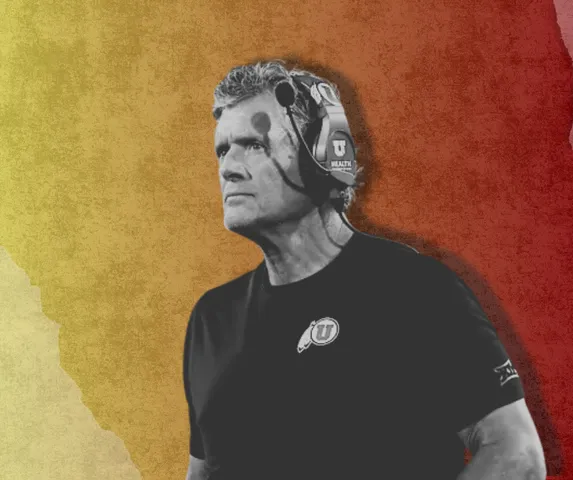

Recently, it was announced that Michigan has finally concluded its search for a new head football coach. The dramatic and highly publicized search began after the dismissal and subsequent arrest of Sherrone Moore and quickly became one of the most speculated coaching hunts in recent memory, which is to be expected for one of the country’s premier football programs. After names like Kalen DeBoer and Kenny Dillingham were floated as potential options, it was announced on December 26 that the Wolverines had selected former Utah head coach Kyle Whittingham.
Whittingham himself had been in the news recently, having announced his retirement after a remarkable 21-year run as Utah’s head coach. Over those two decades, he compiled a .668 winning percentage and won 11 bowl games. The hire surprised many. Despite Whittingham being widely regarded as a strong and steady coach, his age and the fact that he had never previously coached at a traditional “premier” program led many to believe he would not be a serious candidate for a job of this magnitude.
While Whittingham’s move to Michigan has become national news, what many people do not realize is that he was once involved in one of the most chaotic and emotionally charged coaching searches in recent college football history. That search had nothing to do with a championship game, a recruiting battle, or a rivalry showdown on the field. Instead, a coaching decision itself became the center of one of the fiercest rivalries in all of college sports. To understand why, you have to revisit the Holy War.
Before Kyle Whittingham ever rose to national prominence, he had already lived deeply on both sides of the rivalry between the University of Utah and Brigham Young University. Whittingham was an all-state linebacker coming out of high school in Provo. Combined with the fact that his father was a defensive staff member at BYU, it came as little surprise when Whittingham decided to stay local and play for the Cougars.
He enjoyed a successful playing career at BYU before graduating and going on to play professionally in the NFL, the USFL, and the CFL. Not long after his playing days ended, Whittingham found himself right back in Provo as a graduate assistant. After two years as a GA at BYU, his coaching career began in earnest, with stops across the Mountain West region in a variety of roles.
Eventually, the lifelong BYU Cougar found himself working for the enemy. Alongside his father, who had also switched allegiances, Whittingham took the job of defensive line coach at the University of Utah. He quickly rose through the defensive ranks, eventually becoming Utah’s defensive coordinator in 1995, replacing his own father in that role. It was there that Whittingham’s national profile truly began to grow.
Whittingham first rose to widespread national prominence as the defensive coordinator of the undefeated 2004 Utah Utes. Under head coach Urban Meyer, that staff was loaded with future head coaches and coordinators, including Whittingham, Dan Mullen, Mike Sanford Sr., and Gary Andersen, among others. The Utes capped that season with a Fiesta Bowl victory, and finished No. 4 in the final AP Poll.
Following the 2004 season, Urban Meyer was hired away by Florida, leaving Utah in need of a new head coach. Given Whittingham’s defensive success, his role in the undefeated season, and his long-standing ties to the program, he appeared to be the obvious successor. It would have been easy to assume that the transition would be straightforward. In reality, it was anything but.
At the same time Utah was searching for a head coach, BYU was also in the market after a disappointing sub-.500 season. Their top candidate was Kyle Whittingham. The interest made sense. Whittingham grew up in Provo, played at BYU, and coached there as a graduate assistant. Beyond that, three of his brothers played at BYU, his father played there, his mother attended BYU, his wife attended BYU, and his father-in-law was a professor at the university. It would be difficult to find a coach with deeper personal and familial ties to BYU than Whittingham.
Early reports suggested that BYU was the favorite. Whittingham reportedly told BYU that he was accepting the job, and his mother was so convinced of the decision that she told reporters he would be returning to Provo. Local media ran with the story, and it seemed all but official that Whittingham would once again switch sides in the Holy War.
Then something changed.
As reports later surfaced, Whittingham began to reconsider. He met with a group of Utah players to discuss his decision. What followed has been described as a pivotal meeting, one in which the players, led by safety Morgan Scalley, rallied together and made an impassioned case for Whittingham to stay in Salt Lake City. Whatever was said in that room worked. Whittingham ultimately declined BYU’s offer and accepted the Utah head coaching position instead.
He would remain as Utah’s head coach for the next 21 seasons. During that time, Whittingham coached in 17 Holy War games, winning 11 of them. His legacy at Utah became one of consistency, toughness, and sustained success across multiple conferences.
Interestingly, Morgan Scalley’s career path would mirror Whittingham’s in many ways. After graduating from Utah, Scalley became a graduate assistant before rising through the defensive coaching ranks under Whittingham. In 2016, he was named defensive coordinator. A few years later, Scalley was named Utah’s head coach-in-waiting, only to be suspended following an investigation into racist language and stereotyping during recruiting.
Years later, Scalley was again named head coach-in-waiting in 2024. With Whittingham now leaving Salt Lake City for Ann Arbor, Scalley finally inherits the job he had long been positioned to take. According to reports surrounding the transition, Scalley’s growing impatience with Whittingham’s unwillingness to retire may have played a role in how the situation unfolded. Ironically, the same man who once convinced Whittingham to stay may have indirectly helped push him out the door.
Regardless of how one views that ending, Whittingham’s impact on Utah football and the state itself is undeniable. The Holy War will continue, just without the man who once embodied both sides of it so completely. Now, Morgan Scalley takes up the mantle. While he lacks Whittingham’s lifetime of rivalry experience, Scalley will rally the Utes once more and charge forward, just as his mentor did for more than two decades.
If this was your kind of read, you’ll like what’s next. Get The Sandman Ticket, our free, weekly newsletter with picks, insights, and a little bit of everything we love about sports.
Comments