
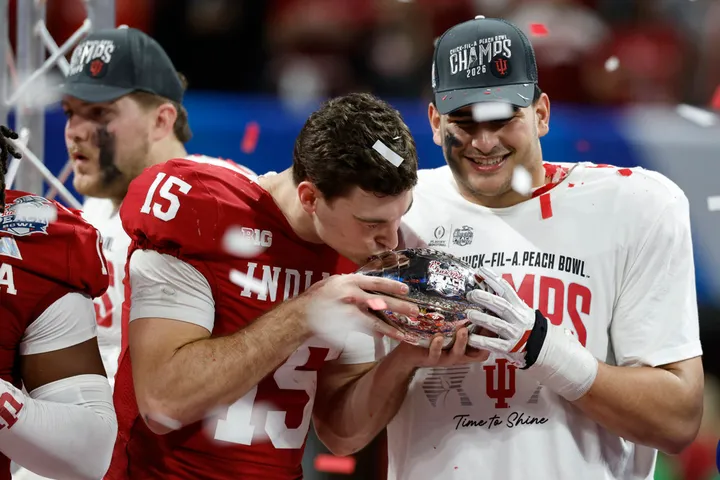

I have raved for the past two years about Curt Cignetti and the job he is doing in Bloomington, Indiana. Just last season, Indiana was the losingest program in FBS history (since clipped by Northwestern). Now they are 15-0 and next week will be playing for the national championship. This team has a Heisman-winning quarterback, Fernando Mendoza, who is on track to become the first Heisman QB to win a title since Joe Burrow and only the fifth in this millennium. He is also projected to be the number one overall pick in April.
Watching Indiana rise from the ashes of Big Ten irrelevance to the brink of a national championship has been surreal, and is one of the greatest storylines college football has produced in years.
But as I watched the second half of last night’s demolition of Oregon, another thought hit me. It is time to stop treating this as a cute story. Time to stop watching in disbelief with our jaws wide open.
What if we are not just witnessing a miracle season? What if we are watching the greatest college football team of all time?
Yes, that is a provocative statement. And yes, it assumes Indiana finishes the job against Miami on January 19th. They are currently 7.5-point favorites, so for the purposes of this argument, we will make that assumption.
If Indiana wins the national title, they will finish 16-0 with a run that already includes a Big Ten Championship win over defending national champion and perennial power Ohio State, along with decisive CFP victories over Alabama and Oregon (for the second time this season), and would add Miami in the title game on the Hurricanes’ home field. Through 15 games, the Hoosiers have outscored opponents 639-166, scoring nearly 43 points per game while allowing just 11. In the Rose Bowl and Peach Bowl alone, they put up 94 on the scoreboard and gained almost 800 yards, winning by a combined 69 points.
This is not smoke and mirrors. This is dominance.
Heisman winner Fernando Mendoza has been the engine of a ruthlessly efficient offense. The defense has smothered top competition, holding Ohio State, Alabama, and Oregon to a combined 175 rushing yards and just 2.6 yards per carry. This team has taken Heisman-level and first-round quarterbacks and forced them into their worst games of the season.
The Historical Standard
The common belief is that only three teams truly belong in the “greatest of all time” discussion: 1995 Nebraska, 2001 Miami, and 2019 LSU.
So let’s stop dancing around it and put Indiana directly in that room.
Snapshot Comparison
| Team | Record | Points Per Game | Points Allowed | Avg. Margin | Notable Angle |
| 1995 Nebraska | 12–0 | ~53 | ~15 | ~38 | Most overwhelming margins, run-game dominance |
| 2001 Miami | 12–0 | ~43 | ~10 | ~33 | Most absurd NFL-level roster and balanced dominance |
| 2019 LSU | 15–0 | ~48 | ~21 | ~27 | Greatest modern QB season and schedule |
| 2026 Indiana | 16–0 | ~43 | ~11 | ~32 | Hardest title path, dominant Playoff run, unprecedented context |
First, the Gauntlet
If Indiana finishes 16-0, their path will be unlike anything those teams faced. They will have gone through Ohio State, Alabama, Oregon twice, and Miami in a true road title game. They did it in the 12-team CFP era, with three playoff wins, in the most competitive era college football has ever seen. NIL and the transfer portal have flattened the landscape. Any program with resources can field a strong roster, and there are no safe weeks.
Indiana is the only team in this conversation that had to endure the 12-team Playoff. Nebraska and Miami never even faced a four-team CFP. Indiana is also the only team in the first two years of the 12-team format to earn a first-round bye and then win their opening game.
It is also worth noting this team can win in a variety of ways, whether it is a 13-10 slugfest over Ohio State or a 56-22 drubbing of Oregon, and while they can shut down teams defensively, they have also put up 50-plus points seven times.
Second, the Dominance
A 639-166 scoring margin, nearly 32 points per game across 15 games, is remarkable by any historic standard. While it does not quite reach Nebraska’s absurd plus-39 per game in 1995 or Miami’s plus-33 in 2001, it belongs in the same conversation. This is not just a good team winning close games. This is a team burying top opponents.
The defensive front in particular mirrors the suffocating style of those all-time greats. Indiana has erased the run games of top offenses and forced star quarterbacks into uncomfortable, mistake-filled performances. That is the hallmark of truly historic teams.
Third, the Context
This is Indiana.
Not Nebraska in the middle of a dynasty. Not Miami at the height of its talent pipeline. Not LSU with endless five-stars and SEC recruiting muscle.
This roster is built on evaluation, development, and portal hits. It is not stacked with blue-chip prospects. This is coaching, cohesion, and execution. The degree of difficulty is completely different. Doing something like this at Indiana is not just rare, it is almost unthinkable.
It is important to note here we are talking about the greatest team ever, not just a compilation of individual talent.
The Honest Comparisons
Against 1995 Nebraska, Indiana can argue structural difficulty. More games. A true multi-round playoff. A tougher postseason path. Modern passing sophistication and defensive versatility that make this team feel more portable across eras. But Nebraska’s scoring margin and lack of close games remain unmatched. That team obliterated an unbeaten Florida offense in a way that still stands alone.
Against 2001 Miami, Indiana can argue schedule and format. The Big Ten plus a three-game CFP run is tougher than Miami’s Big East slate and a one-game BCS finish. Indiana can also say something Miami cannot: they did this without a blue-blood recruiting base. But player for player, that Miami roster remains untouchable. Thirty-eight NFL draft picks. Multiple Hall of Fame trajectories. Indiana will never win a pure talent comparison.
Against 2019 LSU, Indiana can argue defense and balance. This Hoosiers defense looks far more like the old-school juggernauts than LSU’s offense-heavy profile. And the 12-team playoff gives Indiana a postseason résumé that may even surpass LSU’s path. But Joe Burrow’s season remains the most transcendent quarterback campaign the sport has ever seen. Indiana’s offense is very good and efficient, but it is not rewriting the record book in the same way.
So Is There a Greatest-Ever Case?
There is. It is narrow, but it is real.
If Indiana finishes 16–0, with mostly dominant wins over Ohio State, Alabama, Oregon twice, and Miami on the road, they will have endured one of the hardest championship paths any team has ever navigated. In the most competitive era in the sport’s history. With a roster not built on five-star stockpiling. With a defense that erases elite offenses and a Heisman quarterback operating with ruthless precision.
That combination of résumé, dominance, and context is unprecedented.
Are they clearly better than 1995 Nebraska, 2001 Miami, or 2019 LSU in every measurable way? Probably not. The raw margins. The NFL talent. The offensive historical footprint. Those teams still hold enormous weight.
But if Indiana finishes the job, the conversation is no longer hypothetical. This is no longer a Cinderella story. This becomes one of the most complete, difficult, and improbable championship runs in the history of college football. And at that point, dismissing the idea entirely would be outright wrong.
This is not just the greatest season Indiana football has ever had.
If they win it all, it may be the greatest team college football has ever seen.
If this was your kind of read, you’ll like what’s next. Get The Sandman Ticket, our free, weekly newsletter with picks, insights, and a little bit of everything we love about sports.
Comments