
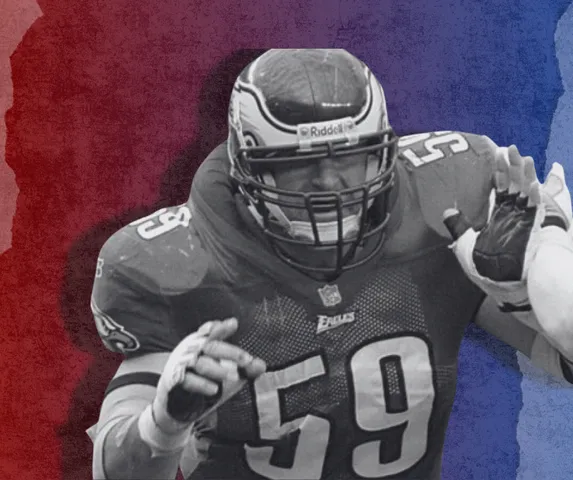

Ask a football fan in your life what they think about Mike Mamula and you will probably get a one-word answer: bust. You might also hear something about him being a “combine warrior” or even a fraud. This has become the dominant narrative surrounding Mamula’s career in popular football discourse. He has been relegated in the public memory to being nothing more than a famously bad draft pick. Mamula has become shorthand for any player who tests well at the NFL Combine but fails to match that success on Sundays. Look up any article about John Ross, Kevin White, or Anthony Richardson, and as soon as their testing numbers come up, Mamula’s name is likely to follow.
But what if that story is incomplete? What if Mike Mamula is not the one-dimensional bust he has been reduced to in the collective football consciousness? What if there is much more to his career than being a throwaway reference in articles about draft disappointments and the history of the NFL Combine?
The most commonly told story about Mike Mamula goes something like this. Mamula is portrayed as a kind of football version of Bernie Madoff or Elizabeth Holmes, a con artist who tricked a team into drafting him despite being completely unqualified. He is described as someone who “gamed the system,” a player who manipulated the pre-draft process through workouts rather than football ability. This version of Mamula appears again and again on lists of famous NFL draft busts. Bleacher Report, for example, ranked him as the 25th biggest draft bust of all time. It is easy to see how this narrative has become entrenched.
According to the popular telling, Mamula was an undersized, relatively unknown prospect who came up with a scheme to boost his draft stock. He supposedly became the first player to train specifically for the NFL Combine, hoping to get selected based purely on his testing numbers. That story has taken on the status of NFL lore. The problem is that large parts of it simply are not true, and what remains is far more unfair to Mamula than accurate.
First, Mamula was not nearly as unheralded as people now believe. As a redshirt sophomore at Boston College, he recorded 11 sacks over the course of the season. Two of those came in the Eagles’ famous upset of No. 1 Notre Dame, a game decided by a last-second field goal. In other words, Mamula had already proven he could perform on the biggest stage against elite competition. He followed that season by taking another major step forward as a junior. In 1994, Mamula posted 17 sacks, an extraordinary number. Sack totals from that era were not tracked as meticulously as they are today, but his 17 sacks would have been enough to lead the nation in 2025. Over two seasons, he totaled 28 sacks. That level of production alone would put any player firmly in early-round draft consideration.
Another part of the Mamula story that does not hold up is the idea that he personally engineered a master plan centered on the Combine. It is well documented that Mamula trained exclusively with Boston College strength and conditioning coach Jerry Palmieri. It was Palmieri’s philosophy that players should train for combine-style testing, not Mamula’s. Preparing athletes for workouts was simply how that program operated. The notion that Mamula independently devised some groundbreaking strategy to manipulate the draft process is largely a myth.
Even setting that aside, Mamula’s testing numbers were genuinely exceptional. Lost in the discourse is the fact that freak athletes will always receive a draft bump. The idea that someone is a fraud simply because they performed well in drills designed to measure athleticism is misguided. Mamula ran a 4.58 forty-yard dash, completed 26 bench press reps, and posted some of the most explosive agility numbers of his era. By modern metrics, his testing would have earned a perfect 10.0 Relative Athletic Score, the highest possible. Even compared to today’s combine prospects, who openly train for these drills because of how much they matter in the draft process, Mamula’s numbers still stand out.
He also was not the undersized project that the mythology suggests. Mamula measured just under 6-foot-5 and 250 pounds. While he may not have profiled as a traditional hand-in-the-dirt defensive lineman and may have been better suited as an outside linebacker in a 3-4 system, it is hardly fair to describe him as physically inadequate for the NFL.
There is also a piece of Mamula’s profile that almost never gets mentioned. He recorded a 49 out of 50 on the Wonderlic, the second-highest score ever at the time. That score topped even Harvard-educated Ryan Fitzpatrick, Rhodes Scholar and surgeon Myron Rolle, and Rhodes Scholar finalist Greg McElroy. Combine that intelligence with elite athletic testing and outstanding college production, and it becomes very easy to understand why a team would be interested in drafting him early. If a player with Mamula’s exact résumé, physical profile, and performance metrics were dropped into the 2025 draft class, it is difficult to imagine that he would not at least be in the conversation for a top-ten pick.
The final and most overlooked part of the Mamula story is his actual NFL career. Despite carrying the label of “bust,” Mamula was, in reality, a perfectly serviceable professional player. Over the five seasons he played, he recorded at least four sacks every year and reached eight sacks twice. He consistently hovered around being a top-20 caliber pass rusher while being asked to play in roles that did not always suit his strengths. That is not the career of an all-time failure. That is the career of an average to solid NFL starter. For a top-ten pick, it may be underwhelming, but it is hardly the catastrophe that his reputation suggests.
What truly doomed Mamula was not his performance, but the context surrounding him. The Philadelphia Eagles selected him hoping he could help fill the void left by Reggie White just two years earlier. That alone created an impossible standard. No one replaces Reggie White. It was also a particularly brutal comparison because Mamula and White were not similar types of players at all. To make matters worse, the Eagles traded up with Tampa Bay to select Mamula. The Buccaneers used the pick they received in that trade to draft Warren Sapp.
From the moment Mamula entered the league, he was being measured against two of the greatest defensive players in NFL history. Reggie White and Warren Sapp are not benchmarks for “good.” They are benchmarks for generational greatness. That is a comparison almost no player in league history could survive. Mamula was never going to look successful next to either of them, regardless of how productive or functional his own career might have been.
This is why Mamula’s reputation has stuck in such a damaging way. His story became less about what he actually did and more about what he was supposed to be. He was not judged against the average top-ten pick. He was judged against legends. When he inevitably fell short of that absurd standard, the verdict was sealed.
Mike Mamula deserves to have his career, or at least the way it is discussed, re-evaluated. His combine performance should be seen as something impressive rather than something suspicious. He did not trick the system. He did not fabricate his athleticism. He was an elite athlete, a highly productive college player, and a capable NFL defender whose legacy was crushed by unrealistic expectations and unfortunate timing.
Mamula has spent decades as the poster child for “combine busts.” But when you actually look at his production, his athletic profile, his intelligence, and the context in which he entered the league, that label falls apart. Mike Mamula was a combine warrior, and that is not something to mock. It is something to respect.
If this was your kind of read, you’ll like what’s next. Get The Sandman Ticket, our free, weekly newsletter with picks, insights, and a little bit of everything we love about sports.
Comments